
Fresh-water rinse after saltwater use.
Service 04
Boat Detailing
Clear away salt and buildup before they wear down the finish.
Planning range$450–$2,500+
Final pricing is confirmed after reviewing the boat, its condition, and access.
Why it matters
Boats deal with salt, sun, minerals, waterline buildup, and repeated wet-dry cycles.
Regular cleaning keeps that buildup from sitting on the finish long enough to become a bigger restoration job.
At a glance
Useful numbers, kept in context.
Full wash during active saltwater use.
Typical full-wash range during active freshwater use.
These are practical maintenance intervals. Storage, use, salt, sun, and marina conditions can change how often a boat needs attention.
How we detail
Purpose in
every step.
Rinse
Saltwater boats start with a thorough fresh-water rinse before contact washing.
Loose salt, sand, and dirt come off first so they are not rubbed across the finish.
Wash
We use marine-safe cleaners and soft tools on the hull, deck, glass, polished metal, and cabin surfaces that are in scope.
The products are chosen for marine materials rather than using a stronger household cleaner just because it is convenient.
Restore + protect
Once the boat is clean, we can see what still needs attention—oxidation, waterline staining, gloss loss, or worn protection.
Polishing and protection are added only where they will improve the finish or make future maintenance easier.
A cleaner rinse
DI water.
Where it helps, we can use deionized water for the final rinse on glass, polished metal, dark finishes, and other areas where water spots show easily.
With most dissolved minerals removed, less mineral residue is left behind as the surface dries.
What we handle
01
Fresh-water rinse and salt removal
02
Hull, deck, and topside washing
03
Glass and polished metal
04
Cabin detailing
05
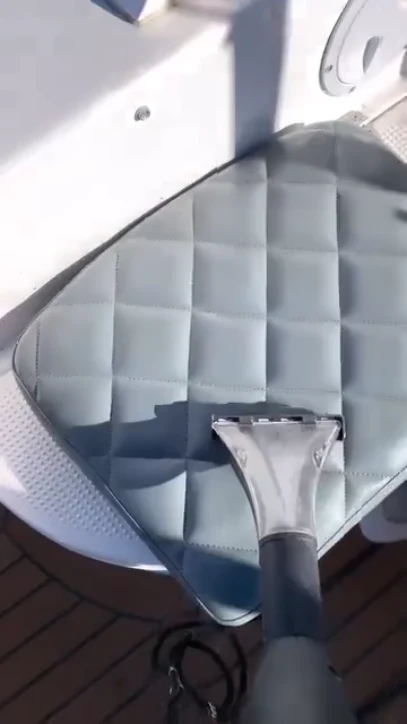
Marine upholstery
06
Waterline cleaning
07
Oxidation correction
08
Wax, sealant, and ceramic protection
Frequently asked questions
A few things
worth knowing.
01How often should a boat be cleaned?+
For saltwater use: rinse after every outing and plan a full wash every 1–2 weeks during active use. For freshwater use: a full wash every 2–4 weeks is a good starting point.
02Can you remove oxidation?+
Often, yes. How much can be corrected depends on how far the oxidation has gone and the condition of the gelcoat or paint.
03Is ceramic coating better than wax?+
Ceramic protection usually lasts longer and can make cleaning easier, while wax is a simpler short-term option. The better choice depends on the boat, finish, use, and budget.
04Does a coating mean I no longer need to wash the boat?+
No. It helps make maintenance easier, but salt and other buildup still need to be removed regularly.
05Can you work while the boat is in the water?+
Often, yes. It depends on dock access, marina rules, the work requested, and which parts of the boat need to be reached.
Southern California. Elsewhere in California by request; travel fee applies.
Request care ↗